
Call for Original Manuscripts for Publication in the Busitema Journal of Science and Education
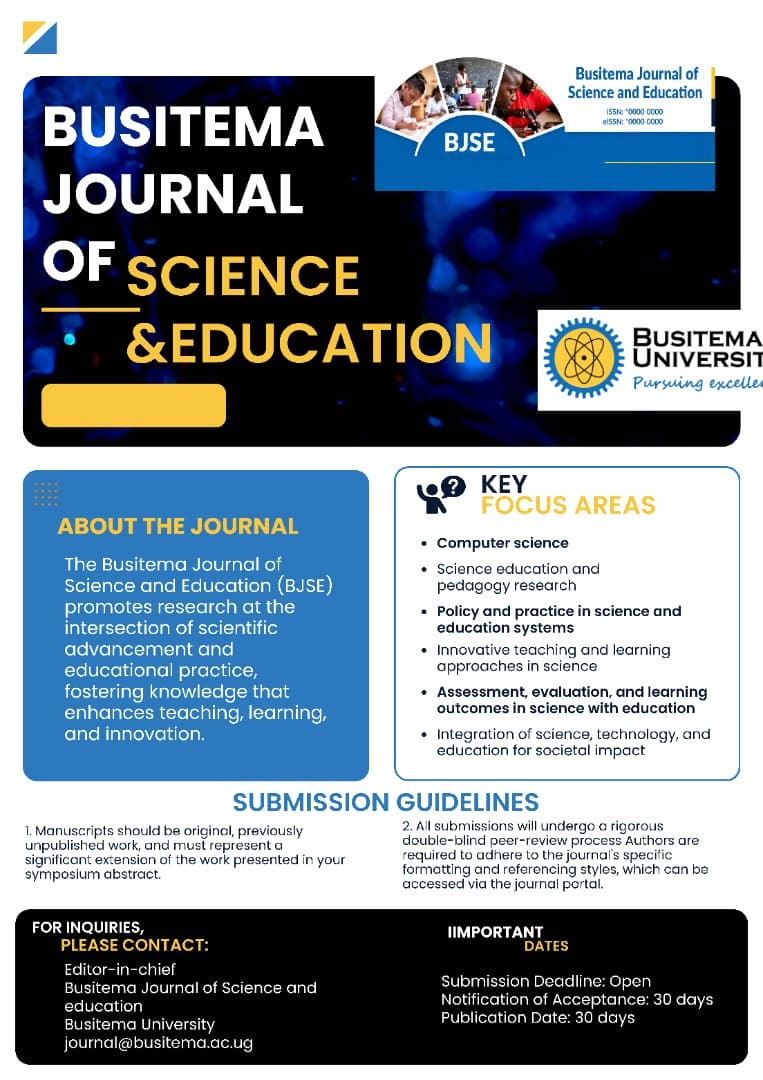
CALL FOR PAPERS
Advancing Research at the Intersection of Science and Education
The Busitema Journal of Science and Education (BJSE) invites submissions of original, high-quality manuscripts for publication in its upcoming issues. As a peer-reviewed, open-access journal, BJSE is dedicated to promoting research that bridges scientific advancement and educational practice, fostering knowledge that enhances teaching, learning, and innovation.
ABOUT THE JOURNAL
In alignment with Busitema University's commitment to academic excellence and capacity building, BJSE serves as a platform for researchers, educators, curriculum developers, policymakers, and students to share research and practice-based insights that connect classroom practice with educational development.
The journal focuses on:
- Advancing research in science education and pedagogy
- Promoting innovative teaching and learning approaches
- Strengthening the integration of science, technology, and education for societal impact
AIMS AND SCOPE
BJSE is a double-blind, peer-reviewed journal focused on research in science, computer science, education, and pedagogy. The journal publishes studies on:
- Teaching and learning processes
- Curriculum development and implementation
- Assessment, evaluation, and learning outcomes
- Classroom practice across science and computer science fields
We welcome work that examines how science is taught and learned, how instructional approaches and curricula can be improved, and how educational innovation can strengthen learning outcomes.
KEY FOCUS AREAS
BJSE welcomes submissions from the following fields, including but not limited to:
- Computer Science and Education
- Science Education and Pedagogy Research
- Policy and Practice in Science and Education Systems
- Innovative Teaching and Learning Approaches in Science
- Assessment, Evaluation, and Learning Outcomes in Science Education
- Integration of Science, Technology, and Education for Societal Impact
- Interdisciplinary Approaches in Science Learning and Instruction
TYPES OF SUBMISSIONS
BJSE publishes high-quality scholarly work in the following formats:
- Original Research Articles – Full-length reports of significant research findings
- Applied Research – Studies addressing practical challenges in science education and pedagogy
- Case Studies – Examinations of curriculum implementation, classroom practice, and innovative teaching approaches
- Review Articles and Systematic Reviews – Comprehensive syntheses of existing literature
- Short Communications and Research Notes – Brief reports of preliminary or timely findings
- Commentaries, Perspectives, and Critical Debates – Thought-provoking discussions on emerging issues in science education, educational innovation, and the integration of science, technology, and learning
TARGET AUDIENCE
The journal serves:
- Researchers and academics
- Science educators and teacher educators
- Curriculum developers
- Policymakers
- Education practitioners
- Students engaged in science and education, pedagogical innovation, and the advancement of teaching and learning
OPEN ACCESS POLICY
All articles published in BJSE are open access, meaning they are freely available to read, download, copy, distribute, and reuse—with proper attribution—under the terms of the applicable Creative Commons license. Authors retain copyright while granting the public the right to use their work following the chosen license.
Licensing Options
Creative Commons Attribution (CC BY 4.0) – Primary License
Under this license, users may:
- Distribute, copy, and share the article in any medium or format
- Create adaptations, including translations and derivative works
- Text/data mine the article for computational analysis
- Use the work commercially, provided proper attribution is given
Conditions: Users must credit the author(s), link to the original publication (via DOI), and indicate if changes were made. Adaptations must not imply endorsement or harm the authors' reputation.
Creative Commons Attribution-NonCommercial-NoDerivs (CC BY-NC-ND 4.0)
For authors who prefer more restrictive terms, BJSE offers this license, which allows:
- Non-commercial redistribution
- Inclusion in collective works
Restrictions: No commercial use and no derivatives are permitted.
Authors may choose this license if required by their funding agency or institutional policy.
ARTICLE PUBLISHING CHARGE (APC)
Unlike many open-access journals, BJSE does not charge any Article Processing Charges (APCs). Publication costs are supported by Busitema University, ensuring that authors can publish their work free of charge while maintaining high editorial and peer-review standards.
This model promotes inclusivity, allowing researchers from all economic backgrounds to contribute to and benefit from open science.
SUBMISSION GUIDELINES
Manuscripts should be submitted in accordance with the journal's formatting and submission requirements. All submissions undergo rigorous double-blind peer review to ensure quality, originality, and scholarly contribution.
For detailed author guidelines, submission instructions, and templates, please visit: Author Guidelines and Submission Instructions
Submit your manuscript via the Submission Portal Link
IMPORTANT DATES
Activity
Date
Submission Deadline
Open
Notification of Acceptance
30 days after submission
Publication Date
30 days after review
CONTACT INFORMATION
Editorial Office
Busitema Journal of Science and Education (BJSE)
Busitema University
Email: journal@busitema.ac.ug; busitemajournals@gmail.com
Website: https://jse.journals.busitema.ac.ug/jse
By publishing in BJSE, authors ensure their work reaches a global audience without financial barriers, promoting evidence-based practices in science education, advancing innovation in teaching and learning, and strengthening knowledge exchange in science education, pedagogy, and related educational fields.
Join us in advancing research at the intersection of science and education. Submit your manuscript today!
BJSE is committed to promoting academic excellence, capacity building, and the advancement of science education for societal impact.